Macroeconomic Oil Shock | Biomanufacturing Legislation | Infrastructure Scaling | Industrial Fermentation
Mushmycel Industry Briefing Vol. 26.05
EXECUTIVE SUMMARY
Macroeconomic volatility in Q2 2026 has structurally altered raw material procurement. The Hormuz oil crisis is eroding the historical cost advantage of petrochemical feedstocks, accelerating industrial adoption of bio-based inputs. Simultaneously, corporate restructuring at tier-1 agricultural processors and bipartisan U.S. tax incentives are mobilizing capital for commercial-scale biomanufacturing infrastructure. For the next-generation material sector, this convergence de-risks the physical scaling of bio-polyurethanes and solid-state fermentation processes.
MACROECONOMIC OIL SHOCK ACCELERATES CHEMICAL DE-FOSSILIZATION
Data & Facts: The 2026 Hormuz oil crisis generated a global deficit of 10 million barrels of petroleum per day. Consequently, petrochemical feedstocks (specifically naphtha, heavily utilized for synthetic polymers) are experiencing severe price volatility and physical shortages across Asian and European manufacturing hubs.
Mechanism: The fundamental cost advantage of petroleum over bio-based equivalents is deteriorating. Industrial producers are integrating bio-attributed feedstocks and drop-in bioplastics to mitigate inflationary risk and supply chain disruptions.
Alternative Material Impact: The price delta between fossil-derived polyurethanes (PU) and bio-based alternatives is compressing. Material developers utilizing mycelium or agricultural residues (apple peel, coffee grounds) can secure bio-based binders and textile backings at highly competitive rates, eliminating the primary economic barrier to achieving 100% petrochemical-free formulations.
U.S. BIOMANUFACTURING LEGISLATION DE-RISKS CAPITAL EXPENDITURE

Data & Facts: The bipartisan Biobased Materials Investment and Production Act, introduced in the U.S. House of Representatives, targets the expansion of domestic plant-based biomanufacturing infrastructure.
Mechanism: The legislation provides manufacturers converting agricultural biomass into materials with two distinct financial mechanisms: a 30% Investment Tax Credit (ITC) for facility construction and retrofitting, or a $0.10-per-pound Production Tax Credit (PTC) capped at $10 million annually. Food and fuel outputs are excluded.
Alternative Material Impact: These tax levers directly subsidize the extreme capital expenditures (CapEx) required for domestic continuous-fermentation and substrate processing infrastructure. Mycelium leather producers can leverage the 30% ITC to finance dedicated commercial-scale growth facilities, shifting production dependency away from outsourced overseas processing nodes.
PRIMIENT LAUNCHES DEDICATED BIOSOLUTIONS BUSINESS UNIT
Data & Facts: Primient, a tier-1 corn wet-milling corporation, restructured its operations to launch a dedicated Biosolutions business unit. Recent capital deployments include a co-location partnership with Sustainea, the iPROOF venture, and the acquisition of a Bio-PDO (1,3-propanediol) production facility in Tennessee.
Mechanism: Primient leverages existing wet-milling infrastructure, feedstock supply chains, and fermentation byproducts to provide commercial-scale manufacturing capacity for biotech startups transitioning from pilot phases.
Alternative Material Impact: The availability of industrial-scale contract fermentation solves the operational scaling bottleneck for next-gen materials. Brands developing bio-fabricated textiles or microbial pigments can utilize Primient's established infrastructure rather than raising capital for proprietary pilot plants. Furthermore, Bio-PDO serves as a core renewable building block for synthesizing the high-performance bio-plastics and resins heavily utilized in vegan leather composites.
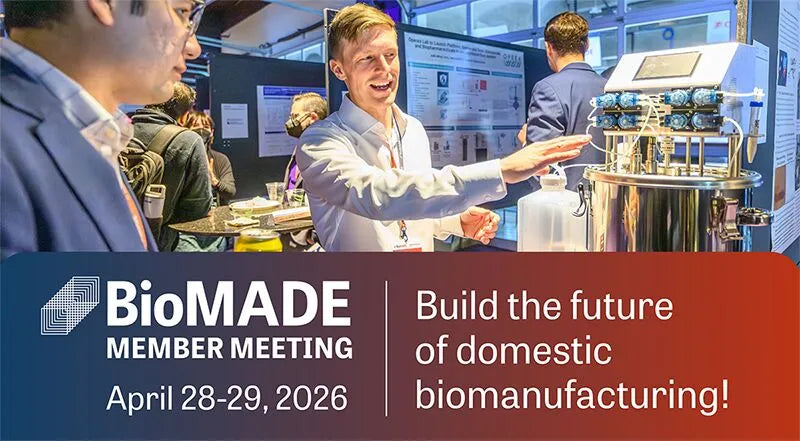
BIOMADE MEMBER MEETING TARGETS MANUFACTURING STANDARDIZATION
Data & Facts: The annual BioMADE gathering convened researchers, engineers, and executives to address structural bottlenecks in U.S. bioindustrial manufacturing.
Mechanism: The operational agenda prioritized technical scaling (cell-free systems, strain optimization), intellectual property strategy, Series A/B funding preparation, and compliance with military-grade (MIL-SPEC) performance standards.
Alternative Material Impact: Standardizing biomanufacturing output is mandatory for B2B material distribution. For agricultural-waste materials and mycelium composites to penetrate institutional supply chains (e.g., automotive interiors, aviation), they must transition from bespoke batch production to continuous manufacturing models capable of meeting rigorous, quantifiable physical parameters like MIL-SPEC.
Source:
https://worldbiomarketinsights.com/an-oil-shock-is-underway-will-industries-go-bio-based/
https://worldbiomarketinsights.com/primient-launches-new-business-unit-for-bio-based-products/
https://worldbiomarketinsights.com/biomade-member-meeting-industry-gathering-for-biomanufacturing/
https://www.greenqueen.com.hk/us-biomanufacturing-bill-plant-based-tax-incentives-materials/